
Maximizing Your Startup's Runway without VCs
Beat the Odds with 5 Proven Ingredients

Of course, you heard the sobering statistic that 9 out of 10 startups don't make it (source). What are the main reasons why they fail? Depending on statistics, 68% to 94% of startups fail because of one of the following three pivotal challenges (source1, source2, source3).:
cash flow dilemma
team constellation
time to product-market fit.
However, you can beat these odds with the right strategies and tools! This guide is tailored for pre-product-market-fit B2B software founders who aim to become a unicorn and a global market to serve.
The Financial Reality for Startups
A typical startup needs more than €500k to reach the product-market fit. Here is why:
Salaries: At pre-seed and seed stages, location has little to no impact on salary. The average founder's monthly salary is €4.16k. (source).
Team Size: Successful startups typically have 4+ full-time team members (source).
Time to Product-Market Fit: The journey to product-market fit typically takes 2-3x longer than anticipated (source), often spanning 2-3 years (source).
Let’s face it - it’s improbable you get €500k secured. Here is what funding statistics look like for 2000 average startups (source):
760 get funded by friends and family (€23k raised on average)
18 get funded by angel investors (€75k raised on average)
1 gets funded by a VC fund (€6M raised on average)
The only way out is to make sure your team members share more than 90% of your entrepreneurial risks with you. How? There is only one way. You need to reward them with equity!
Case study: Inguro's Blueprint for Success
To put these challenges into perspective, consider the story of Inguro.
After 3.5 years after incorporation, Inguro is still on its journey towards product-market fit. They have 6 contributors (2 full-time and 5 part-time) at the time of writing. One would expect their monthly expenses to be in the ballpark of €20k. Yet, Inguro streamlined their burn rate to just €6.5k! In the course of 3.5 years, Inguro raised a total of €325k from 14 angels. With their current burn rate, they have a runway of more than 2 years.
How can you replicate the same success? How do you push your burn rate down and extend your runway? How do you increase your chances of raising money from angels? How do you acquire great advisors and convert them into angels? Read on to learn about the 5 essential Ingredients.
Ingredient 1: Incorporate your company as soon as possible
No investor would invest in a non-incorporated company. Similarly, convincing potential contributors to invest their time in your non-incorporated startup is much harder. As a founder, you must win the trust of partners, investors, co-founders, customers, etc. The easiest way to increase trust in your dedication as a founder is to incorporate your startup as soon as possible. But where?
For 95% of B2B software founders, the best decision is to incorporate as Delaware LLC! Here is why:
In 2022 alone, more than 313,650 businesses registered in Delaware (source).
Delaware is home to Amazon, Google, Tesla, Walmart, American Express, and Disney.
Incorporating in Delaware offers startups tax advantages, enhanced privacy, and, most importantly, a massive market of hungry investors willing to invest in Delaware companies.
In 2021, there were 363,460 active angels (source). In the same 2021, none of the top European countries, including the UK, Germany, France, Spain, and Turkey, had more than 10,000 active angel investors, with the UK reaching that peak (source).
Forming a Delaware company usually takes a few weeks, is entirely online, and costs just $399, e.g., with firstBase.io.
Incorporating is a straightforward and concrete action demonstrating a founder's commitment and seriousness to stakeholders and potential investors.
Ingredient 2: Create a culture where the best ideas win
When convincing new team members to share considerable entrepreneurial risk, you must offer more than just equity. People value company culture where they have meaningful relationships and work.
An idea-meritocracy is a company culture where the best ideas win (and not the person with the highest hierarchy). For idea meritocracy to work, it’s vital to:
Seek Evidence-Based Conversations: Blend empirical data with experiential insights for richer discussions.
Focus on Mutual Understanding: Make sure your conversation partner feels you understand them before you disagree with them.
Ensure Psychological Safety: Lead by example, regularly ask, and provide constructive feedback. You must make it easy to express subjective truth doubts and acknowledge mistakes.
Idea meritocracy will flatten the hierarchy and increase your team's effectiveness (source). Your team members will perform better, feel happier, and be more dedicated to your startup (source).
Ingredient 3: Build a Board of advisors as early as possible
Having a great board of advisors will ensure you are never the smartest person in the room. Here is why you need it:
You improve the quality of your decisions, shorten the time to product-market fit, and enjoy a positive impact on your future profitability and sales (source1, source2).
Due to the Halo Effect, having a reputed board of advisors will spill over positive perceptions of your startup, enhancing its attractiveness and credibility in the eyes of investors, potential customers, and contributors.
As you listen and act upon advice from your advisors, they become more invested. Advisors often become angel investors due to the sunk cost fallacy because they feel their initial time and effort should be backed by a financial commitment (source).
It's crucial to have advisors who can address gaps in hiring, business strategy, management, product development, finance, sales, and marketing. While expertise in your specific product domain is valuable, you can often gain these insights directly from your users.
Ingredient 4: Require every contributor to share entrepreneurial risk with you
As discussed previously, you need all your contributors to share entrepreneurial risk with you to achieve product-market fit. With more skin in the game, you can trust them more.
There are two dimensions of risk-taking: equity/cash balance and the number of committed hours. The fewer hours a contributor invests, the easier it is to make an equity-only deal. We can rank contributors according to their ability to share entrepreneurial risk with you as follows:
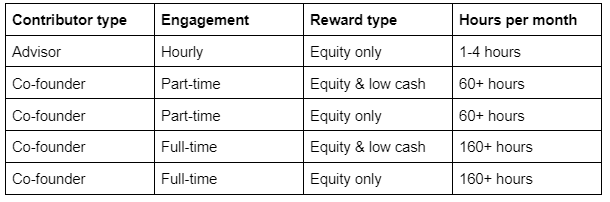
Let’s highlight a few essential points:
“Low cash” means sacrificing at least 75% of their market salary.
We recommend not to work with advisors who want to be paid in cash. Best advisors are motivated by equity only because they want to have the skin in your game.
The more skin in the game a contributor has, the more you can trust the person because when you lose, the person fails, too.
We don’t recommend part-time contributors below 60 hours monthly. You have only very few contributor seats in your startup, and we recommend you reserve them for those who can commit more time.
Due to cognitive biases such as mental accounting and loss aversion, your (potential) contributors often perceive time and money differently. Being tangible and immediately quantifiable, money is treated with a heightened sense of ownership and protection. The endowment effect amplifies this, as people overvalue what they possess monetarily. Meanwhile, despite its finite nature, time is seen as more abstract, and its value might only sometimes be recognized, especially if the benefits of investing that time aren't instantly evident. Consequently, many contributors might be more inclined to invest their time in your startup, viewing it as a less immediate loss than investing with their money.
Building on the Commitment and Consistency Bias, when your contributors have a tangible stake in your startup, they are more likely to remain dedicated and consistent in their efforts. This stems from their intrinsic desire to act in ways consistent with their previous commitments, especially when they have significant implications, such as financial stakes.
Ingredient 5: Fundraise continuously with convertibles
Investors often hesitate to fund startups, waiting to see if others invest first. Convertible notes allow startups to offer better deals to early investors, encouraging faster decisions. This method provides flexibility and avoids setting a fixed fundraising target (source). Catering to investors' psychology, especially angels, there's an innate desire to secure a deal that's better than what others might get. Convertible notes create this perceived advantage. By offering differentiated conditions for early investors, convertibles generate a sense of exclusivity and better valuation, making investment propositions far more enticing. Here are the advantages:
Convertible notes speed up deal closures by breaking investor deadlocks.
The primary influence on investors is other investors' opinions, leading to a wait-and-see approach.
Convertible notes reward early investors with better terms, reflecting their higher risk.
Flexible terms can be given based on an investor's value to the startup, encouraging differentiated investment conditions.
The traditional fixed-size equity rounds are suboptimal, as startups cannot predict optimal round sizes in advance, making flexibility vital.
To make the best use of convertibles, you need to adjust the cap, interest, and discount to make the offer attractive to each angel investor.
Summary
Most startups face a steep battle against three principal challenges - cash flow issues, team dynamics, and the long path to product-market fit. With an average of only 1 in 2000 startups getting VC funding, entrepreneurs have no other choice but to motivate their team members with equity.
As a beacon of hope, Inguro's case study showcases how to maximize your runway. The following five ingredients will prolong your runway:
Swift Incorporation: Start by incorporating your startup as early as possible, preferably as a Delaware LLC.
Cultivate an Idea-Meritocracy: Teams are more productive and motivated in an environment where the best ideas prevail.
Establish a Board of Advisors: This not only improves decision-making but also increases your startup's credibility and makes it easier to fundraise.
Share Risk Among Contributors: Prioritize working with people who share much of your entrepreneurial risk.
Use Convertibles for Fundraising: Convertible notes are flexible and reward early investors, making them a perfect tool for startups to attract and retain investors.
Thanks to Tomas Rehor, Cedric Maloux, and Sebastian Voráč for sharing proofreading and sharing your feedback, and improvement suggestions!
About the author: Vyacheslav Ladischenski, the founder of Inguro and community builder at 22minds.
About 22minds: We offer a Board of Advisors as a service in exchange for equity for pre-revenue and pre-MVP startups. Feel free to reach out via telegram.
About Inguro: Close relationships matter. We help B2B sales unleash the power of their LinkedIn network to eliminate cold outreach. It’s a new professional people search with results sorted by predicted credibility. Try it for free.